


Secondary school student Manca Boh, under the mentorship of Dr Jane Kolar, Director General of the National and University Library of Slovenia (NUK), has completed an interdisciplinary research project on the manuscripts of Srečko Kosovel, one of the most important Slovenian poets of the 20th century. The project, which grew from a summer placement at NUK into an extensive research initiative, has provided important new insights into the chronology of Kosovel’s poetry and demonstrated the potential of non-invasive chemical analysis methods for the study of manuscript cultural heritage. This year, the project received first prize and a gold award at Slovenia’s national young researchers’ competition.
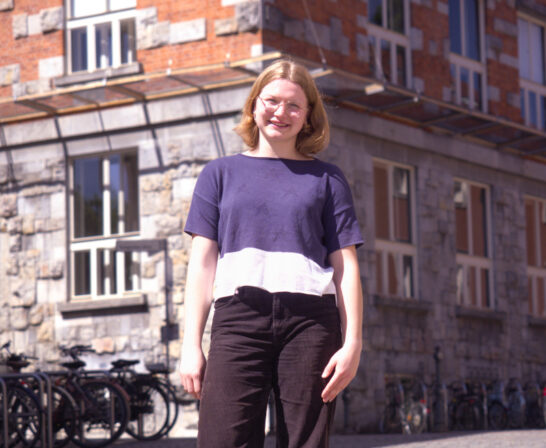
Manca Boh, a student at Gimnazija Želimlje secondary school, combined her interests in literature and natural sciences in a research project linking chemistry and chemical technology with Slovenian language and literary studies. Under the mentorship of her teacher Eva Lajevec and the co-mentorship of Dr Jane Kolar and Dr Hend Mahgoub from the Faculty of Chemistry and Chemical Technology at the University of Ljubljana, she investigated the chronology of Kosovel’s manuscripts through the analysis of inks used in the poet’s handwritten texts.
One of the project’s initial assumptions was that, due to modest material circumstances, Kosovel likely used a limited number of inks and worked on multiple texts simultaneously. The chemical composition of the inks could therefore help establish the time frame in which individual manuscripts were created, despite being written on different types of paper and printed materials.
The research represents a pioneering interdisciplinary approach that combines chemical analytical methods and literary studies in the examination of manuscript material from Slovenia’s cultural heritage.
By analysing the chemical composition of inks in approximately 50 dated and undated manuscripts, the researchers identified three potential ink groups that can be linked to different periods of the poet’s creative work. The findings also suggest that stylistically diverse poems — ranging from impressionist and expressionist to constructivist works — were most likely created in parallel within a relatively short period of around two years. This supports the theory that Kosovel’s literary development did not follow a strictly linear progression, but that different poetic styles evolved simultaneously.
The study demonstrated that non-invasive spectroscopic methods, supported by multivariate data analysis and machine learning techniques, can significantly complement literary-historical approaches to the study of Kosovel’s oeuvre. The findings confirm the potential of this multidisciplinary approach and open new possibilities for the research of manuscript and archival material within Slovenia’s cultural heritage.
The success and visibility of the project are particularly meaningful in the year dedicated to Srečko Kosovel, as the research offers an innovative way of bringing the poet’s legacy closer to new generations.
Manca Boh presented the project at the 60th National Young Researchers’ Meeting in Slovenia, where it won first place in the interdisciplinary category and received a gold award.
The project had already attracted broader public attention earlier this year: in March, Manca Boh and NUK colleague Ajda Zavrtanik Drglin, coordinator of the citizen science project From Manuscript to Word, presented related research on Kosovel’s manuscripts at the Science Slam event at Kino Šiška Cultural Centre in Ljubljana, where they won second place.