


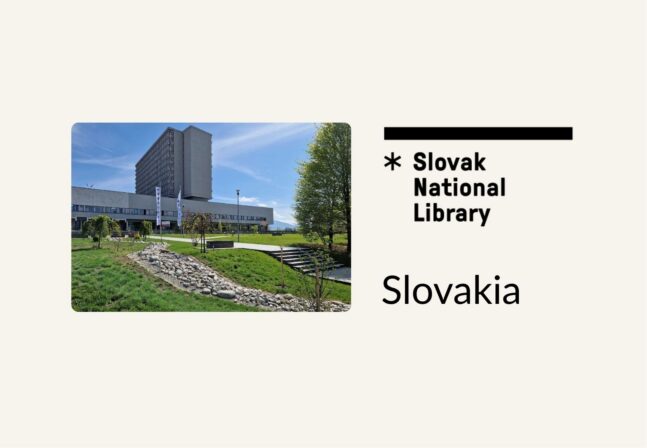
The collections of the Slovak National Library span more than a thousand years of the history of written and book culture in Central Europe.
Among the oldest documents is an 11th-century musical fragment that survived only because it was used as the cover of a later printed book. A unique collection of approximately 800 incunabula documents the beginnings of book printing in Europe. Extensive collections of more than 5 million books, journals, photographs, and manuscripts in dozens of languages allow visitors to trace the development of written culture across the centuries. In addition to Slovak and common languages, the library also preserves documents in Sogdian, Pali, Xhost, Bashkir, and Ottoman Turkish. Although many of these languages are now virtually extinct, they remain part of the written memory preserved for future generations. These rare documents also contribute to the picture of Central Europe’s written culture—a region where languages, traditions, and political entities converged.
The roots of the Slovak National Library date back to 1863, when the systematic collection of manuscripts, documents, and museum collections began. It became an independent institution on July 1, 2000. Since then, it has developed into a modern national library integrated into the European network of memory institutions and is a proud member of the international networks CENL, IFLA, and CERL, which connect national libraries, research institutions, and cultural institutions around the world.
Its headquarters building in Martin was constructed between 1964 and 1975 as a technologically exceptional structure for its time, utilizing the innovative method of precast concrete slabs. Both the interior and exterior are adorned with works by leading Slovak painters and sculptors, created as part of the architectural concept. The building thus comes across as a cohesive work of art in which architecture and the visual arts blend naturally.
Mass digitization—one of the most effective methods of document preservation (2012–2015)—has brought it into the 21st century and expanded the possibilities for making the collections accessible online. It is a memory institution where written heritage is preserved, connected, and made accessible across centuries and cultures.
Read more on the national library’s page on CENL.