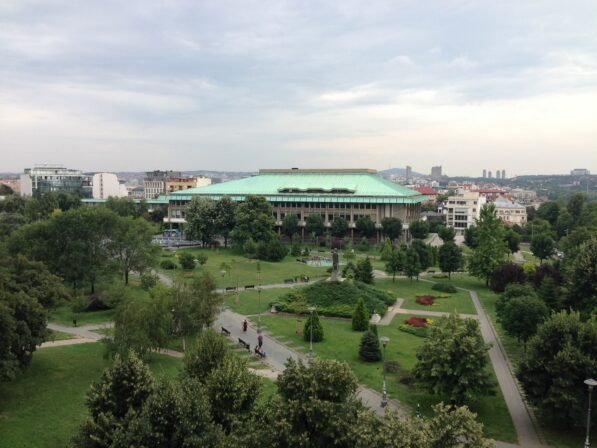
Situated in the heart of Belgrade, next to the Temple of Saint Sava, the National Library of Serbia proudly stands as the oldest cultural institution in our country. It is the umbrella, parent institution, for all public, academic, school, and special libraries in Serbia, tasked with preserving cultural heritage and advancing library and information activities.
February 28, 1832 – On this day, politician and bookseller Gligorije Vozarović established a public library in his shop, and Prince Miloš Obrenović ordered later that same year that one copy of every printed book be granted to the library.
April 6, 1941 – During the German bombing of Belgrade, the library building was burned to the ground. A book fund of about 500,000 volumes, a collection of 1,424 Cyrillic manuscripts and charters (from the 12th to the 17th century), incunabula, old printed books, as well as the entire periodicals collection and personal archives, were irreversibly destroyed.
April 6, 1973 – The library officially opens the doors of its new, purpose-built building where it is located today.
Today, the National Library of Serbia preserves an exceptionally rich collection numbering over 6 million library units. The electronic catalogue contains over 4 million bibliographic records, while the shared cataloguing system connects it with 278 libraries across Serbia.
The library features multiple reading rooms with a total of 600 seats.
NBS is a pioneer of digitization in the Balkans. Its Digital National Library of Serbia contains millions of digitized pages of old manuscripts, newspapers, magazines, books, and photographs.
By organising literary evenings, exhibitions, scientific gatherings, and international conferences, the Library actively shapes the cultural life of the capital and connects Serbia with the world.