


On 27 May 2026, the National and University Library (NUK), Slovenia, opened the major exhibition Lost over Time: Medieval Manuscript Fragments. For the first time in Slovenia, the exhibition places preserved remnants of medieval books at the centre of attention, revealing how these fragments deepen our understanding of medieval scripts, books, and the intellectual life of the past. The exhibition’s author, DDr. Nataša Golob, prepared an exceptional selection of original medieval manuscript fragments from NUK — which holds the largest collection of medieval manuscripts in Slovenia — as well as from numerous other Slovenian institutions and selected examples from abroad. Accompanying the exhibition is a richly illustrated publication of the same title, produced in cooperation with the University of Ljubljana Faculty of Arts Press.
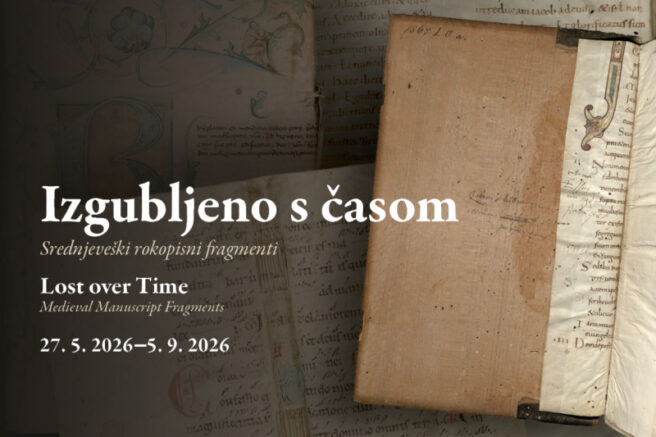
Medieval manuscript fragments are surviving parts of former books that have only partially endured through the centuries — sometimes as individual leaves, but often merely as small pieces of parchment. After their original use had ended, many manuscripts were cut apart and reused in the bindings of later books or archival materials. Since only approximately five to seven percent of all medieval manuscripts have survived to the present day, fragments today represent one of the most important sources for the study of medieval written culture. Even the smallest preserved remnants can significantly enrich our understanding of medieval cultural and intellectual history. Although often overlooked, these fragments offer insight into former libraries, scriptoria, educational environments, and the intellectual networks of medieval Europe. At least 1,500 fragments survive today in the libraries and archives of Ljubljana alone, most of them originating from ecclesiastical, monastic, and secular collections from the territory of present-day Slovenia.
The material presented in the exhibition comes from across Slovenia and is the result of extensive and demanding research, collection, identification, and reconstruction of scattered remnants of former books that are now preserved in a wide range of archives, libraries, and collections. Visitors can discover how researchers identify the age of manuscripts, characteristics of scripts, the origins of individual texts, and the routes by which they circulated throughout Europe from even the smallest surviving fragments.
According to the exhibition’s author, DDr. Nataša Golob, the fragments also reveal the close connections between the Slovenian lands and the cultural and educational centres of medieval Europe: “Whatever their appearance today, we repeatedly discover that these are leaves from manuscripts produced in Italian and French regions, while the majority of fragments originate from areas where the scripts of Austrian and German schools prevailed. These works were probably also produced in Carniola, although the scribes themselves had mastered the art of writing in places north of the Karawanks that possessed excellent schools, including universities, and then brought those writing styles back with them — to our towns and monasteries, castles, and ecclesiastical libraries.”
The exhibition Lost over Time: Medieval Manuscript Fragments will remain on view at NUK until 5 September.