


The National Library of Latvia, in cooperation with the Ministry of Culture of the Republic of Latvia and the Ministry of Economics, has completed the European Union Recovery and Resilience Facility energy-efficiency project “Solar Park for Self-Consumption Electricity Supply at the National Library of Latvia.”
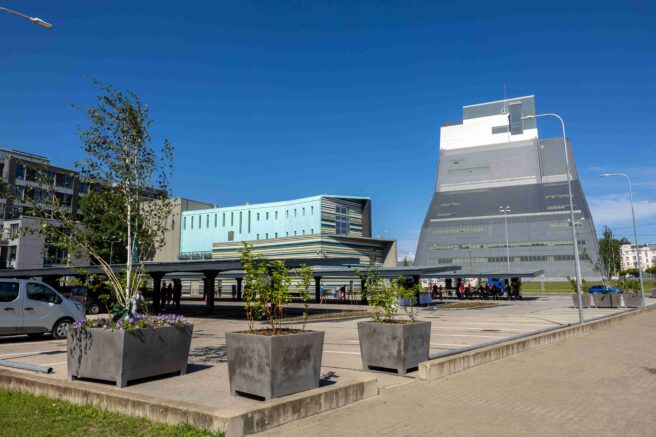
The objective of the investment project: to invest in the infrastructure of the National Library of Latvia building and its surrounding grounds at 5 Mūkusalas Street, Riga, in order to achieve at least a 30% reduction in primary energy consumption. As a result of the project, annual primary energy savings of 451.60 MWh will be achieved in the building, amounting to approximately 180%.
Several activities were carried out as part of the project, including the construction of a solar park with canopies and solar panels on the building, the replacement of outdoor lighting with LED lighting, and landscaping works associated with the extension of the Daugava River water intake pipe.
The project included the installation and construction of:
Juris Ģiedris, Director of the Facilities Management Department at the National Library of Latvia and Project Manager, highlights the unforeseen circumstances and challenges encountered during construction: “As the construction works were carried out within the protection zone of Riga’s historic centre, we encountered a number of complications, particularly during the design and approval process. Given that there are no comparable structures in the city, the overall project implementation process was significantly delayed. We had to abandon plans to install additional solar panels on the roof of the building. All buildings and structures within the protection zone of the historic centre must fit into a unified architectural concept, and this requirement has been complied with. Several unforeseen circumstances also arose during the construction phase. For example, January brought unusually low temperatures that persisted for an extended period, coinciding with the concreting of the piles. Construction works were temporarily suspended until a solution was found which, although it slightly increased construction costs, it allowed the construction work to resume.”
Project implementation period: 29 December 2023 – 31 July 2026.
Project funding: EUR 1,705,495, of which EUR 1,428,864.16 was provided by the European Union Recovery and Resilience Facility and EUR 276,630.84 from the state budget.
Construction contractor: the consortium “DEVRE AE” (SIA “Devre” and SIA “Velve AE”). Construction design: SIA “Balts un melns”; construction supervision: SIA “JV Projekts”. The activities related to the extension of the Daugava River water intake pipe were carried out by SIA “Beltes Būve”. Construction design: SIA “Kurbada Tilti”.
The European Union Recovery and Resilience Facility (RRF) is a budget programme centrally managed by the European Commission, established in addition to the European Union’s multiannual budget for the 2021–2027 programming period. The programme aims to support reforms and investments related to the transition to a green and digital economy, as well as to mitigate the social and economic impact of the crisis.
Latvia’s Recovery and Resilience Plan was approved by the European Commission on 22 June 2021 and by the EU Economic and Financial Affairs Council (ECOFIN) on 13 July 2021. The approved Recovery and Resilience Facility funding available to Latvia amounts to EUR 1.97 billion and will be available until 31 August 2026.