


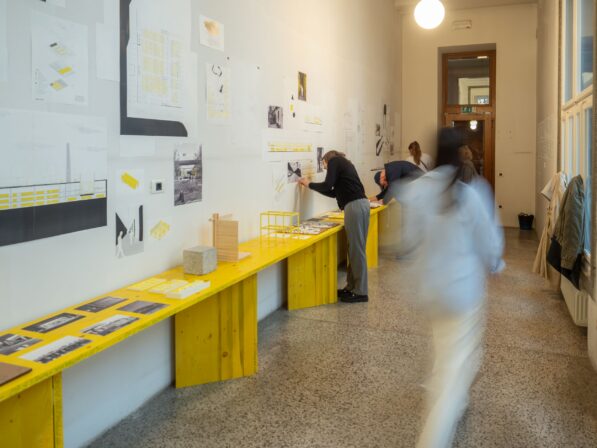
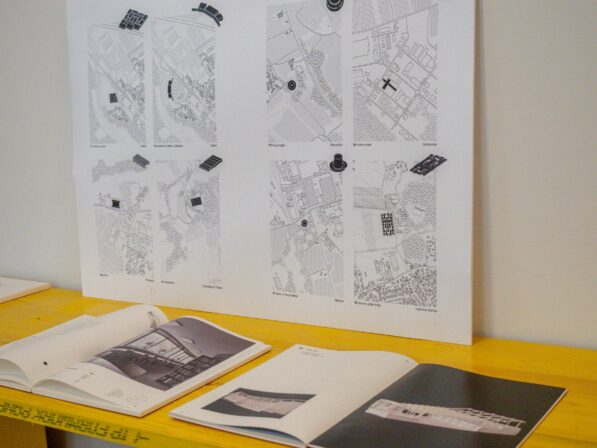
A new exhibition, NUK Storage Facility: Reflections on the Future Storage of Library Materials, has opened at the National and University Library (NUK). It presents thirteen conceptual designs for modern, low-carbon library repositories created by students from the Faculty of Architecture at the University of Ljubljana. The projects explore innovative approaches to the long-term preservation of Slovenia’s written cultural heritage in the context of climate change, bringing together architecture, sustainability, and heritage science.
The exhibition is the result of a collaboration between NUK, the Faculty of Architecture at the University of Ljubljana, and the Slovenian National Building and Civil Engineering Institute (ZAG). Within the framework of the MitiClim project (Climate Change Mitigation Strategies for the Protection and Preservation of Slovenian Written Cultural Heritage), the partners are jointly exploring new concepts for the next generation of library repositories.
Decades of Space Constraints
For decades, NUK has faced a critical shortage of storage space and inadequate conditions for preserving its collections. With its existing repositories nearing full capacity, the library is now preparing professional guidelines for the development of a new storage facility that will ensure the long-term preservation of Slovenia’s national collection. At the exhibition opening, NUK Director Dr. Jana Kolar emphasized the urgency of the situation:
“Our existing storage capacities are almost entirely full. As a result, some of the material is currently stored in drawers along hallways, in staff offices, and at various locations throughout the library. Certain collections are scattered across seven different sites. Given the current growth rate of our collections, we expect NUK’s final space reserves to be completely exhausted in about a year.”
In the era of climate change, the storage of library materials is also becoming a question of energy efficiency and the long-term sustainability of cultural institutions. Through the MitiClim project, the partners are developing solutions that both safeguard cultural heritage and reduce energy consumption while adapting to changing environmental conditions.
Collaboration and Sustainable Design
The conceptual designs presented in the exhibition were developed in collaboration with Alen Hausmeister of the Department of Building Physics at the Slovenian National Building and Civil Engineering Institute (ZAG), together with participants in the design seminars at the Faculty of Architecture, University of Ljubljana. The students were mentored by Asst. Prof. Mitja Zorc, Prof. Anja Planišček, M.Arch., Asst. Mina Hiršman, Asst. Tadej Urh, and Alen Hausmeister.
Mihael Dešman, Dean of the Faculty of Architecture at the University of Ljubljana, highlighted that preserving original documents for future generations carries immense scientific, research, symbolic, and cultural significance—particularly in an age shaped by digital technologies and artificial intelligence.

In their projects, the students explored a range of architectural approaches to designing a contemporary library repository, investigating passive environmental strategies, energy-efficient materials, and other sustainable design solutions.
As mentor Mitja Zorc noted, one of the key stages in developing the projects was rethinking the relationship between spaces dedicated to books and those designed for people:
“While the renowned architect Jože Plečnik originally designed NUK as a symbol of national emancipation, these project proposals remind us that today’s challenge is to design a building that serves as a sensitive and responsible mediator between the environment, the book, and people.”