



About KBR
The Royal Library of Belgium (KBR) is the national scientific library of Belgium. It collects all Belgian publications and preserves, manages, and studies an extensive cultural and historical heritage comprising more than eight million documents.
KBR provides the public with access to information, facilitates research, and offers cultural experiences. By creating new connections between people, knowledge, and heritage, KBR enables society to discover, interpret, study, and reuse its cultural memory.
The Burgundian Library
KBR preserves 279 manuscripts from the prestigious Library of the Dukes of Burgundy, one of the most impressive manuscript collections of the Middle Ages. It was assembled by the Dukes of Burgundy, who ruled over the Low Countries in the 14th and 15th centuries. It was Philip the Bold, the first Duke of Burgundy, who laid the foundations for what would grow into an extraordinary library.
At the death of Philip the Good, the library contained around 900 manuscripts of exceptional quality. It was not only one of the largest, but also one of the most beautiful libraries of its time—alongside those of the French kings, the Medici, and the papal library.
Amazingly, around 400 of these beautifully illuminated manuscripts have been preserved. Of these, 279 are part of KBR’s collections, while the rest are spread across 35 libraries worldwide.
Now, you can also explore the complete collection online and zoom in to discover the smallest details of the finest miniatures or admire them in the KBR museum.
The Library of the Dukes of Burgundy: Centuries-old splendor now digitally accessible • KBR
About the building
The KBR building was constructed between 1954 and 1969 by architects Maurice Houyoux, Roland Delers and Jacques Bellemans.
The building stands on a 13,000 m² site, but its many levels and floors provide a total surface area of 67,000 m². The spaces dedicated to readers cover 8,000 m² and offer 1,100 seats.
The storage areas where the collections are kept contain nearly 150 km of shelving, of which around 50 km is located underground, while the remaining 100 km is spread across the tower’s 10 floors. Only levels -5 and -6 are equipped with a compact shelving system (mobile stacks).
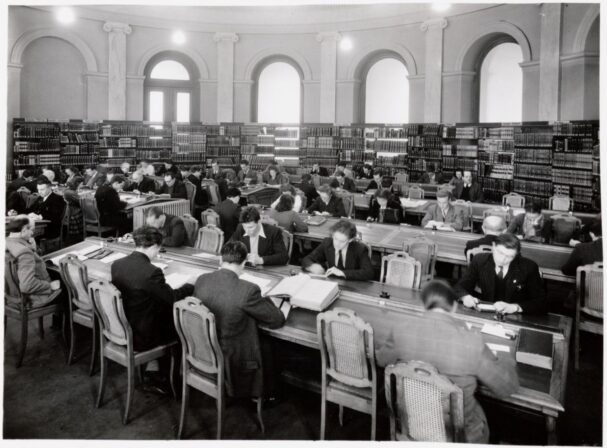

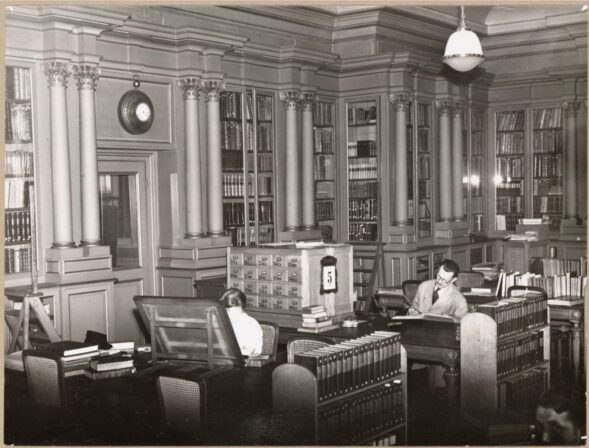
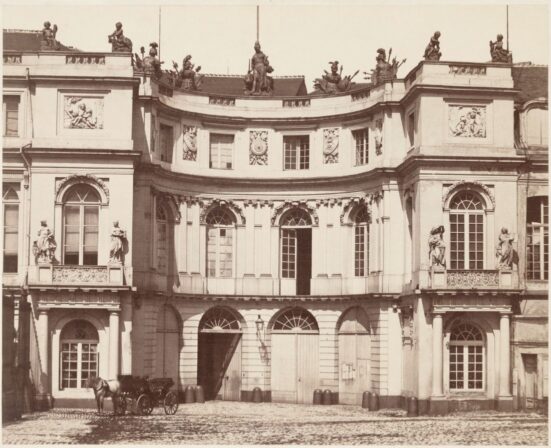
From 1839 to 1969, the Royal Library was housed in the Palace of Charles of Lorraine.
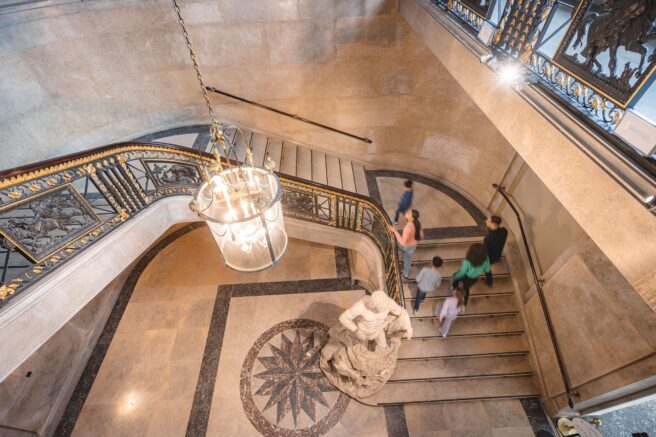
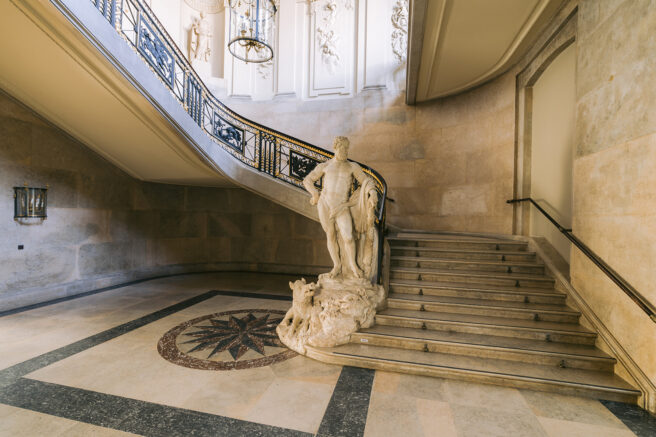
An impressive staircase, adorned with a statue of Hercules sculpted by Laurent Delvaux, leads up to the first-floor rotunda. The rotunda’s paving includes a central rosette made up of 28 types of Belgian marble, a sample of the Prince’s collection of 5,000 minerals.
This wonderful floor art leads to five rooms decorated with stuccos and silk, where the governor would entertain his guests and take care of state affairs.

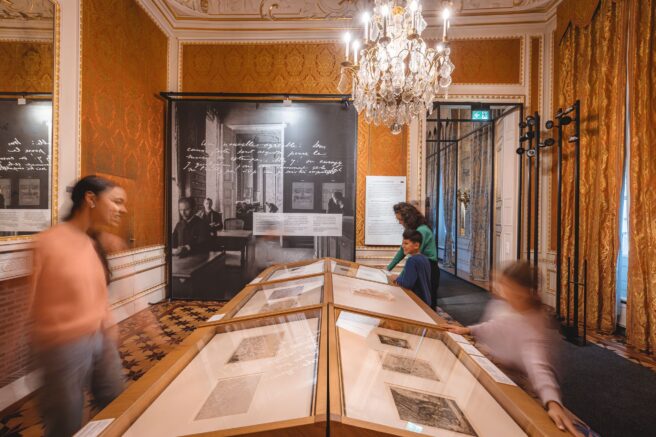
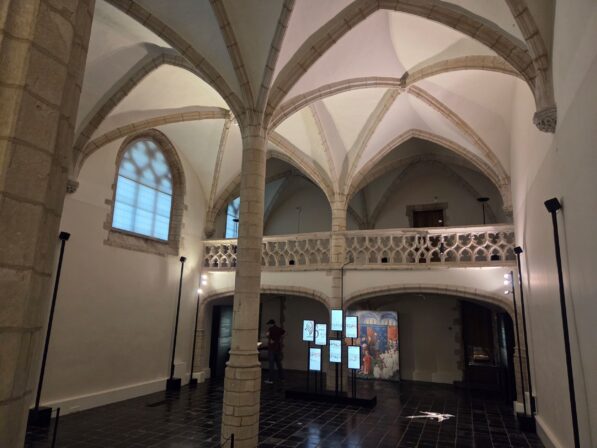
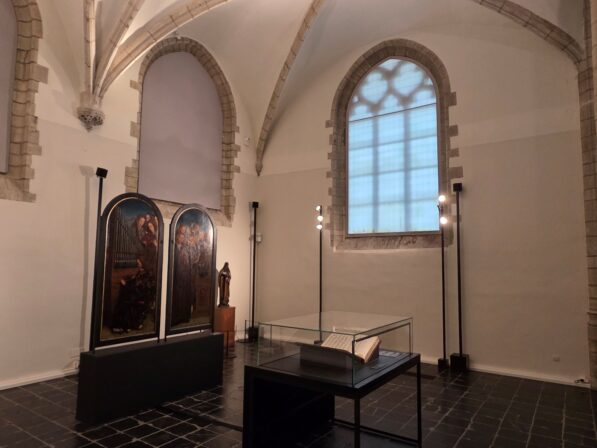
If you stand on the Mont des Arts and look closely at the KBR building, you can spot the outer wall of the Nassau Chapel through the monumental peristyle. The chapel is incorporated into the modern building of the national library and is today part of the KBR museum.
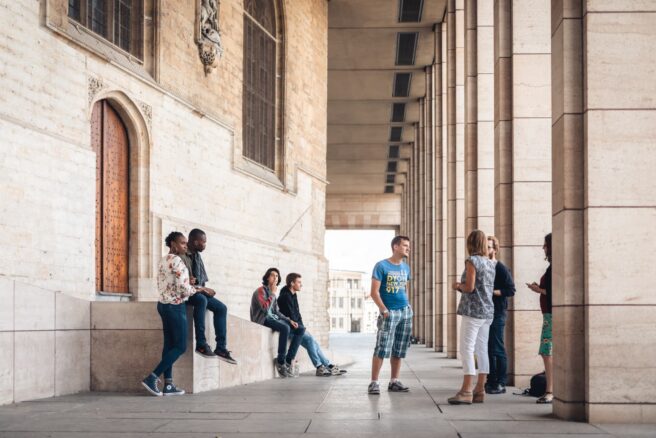
From the 19th century onwards, the chapel had very different functions. It was rented to a brewer until 1839, then used as a temporary storage place for the oeuvre of sculptor Mathias Kessel, which the state purchased in 1839 and which today forms the core of the collection of the Royal Museums of Fine Arts of Belgium.
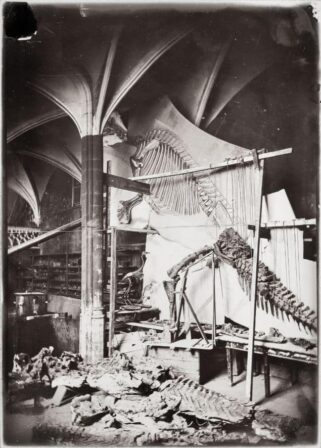
In 1862, the chapel served as the laboratory of the Royal Museum of Natural Sciences, which opened in 1814 in the former Court. Thanks to old photographs, we know that the assembly of the iguanodons from Bernissart, discovered in 1877, took place in the Nassau Chapel. The location of the beam used for this delicate undertaking is still visible in the chapel today (see photo below).
The Nassau Chapel is now part of the KBR museum, where you can explore the 15th century in our region through the images, stories and characters from the Library of the Dukes of Burgundy. Discover Europe’s medieval cultural past against the backdrop of the sixteenth-century Chapel of Nassau.
Read more on the national library’s page on CENL.