


One of the interesting items from the Special collections of the National and University Library of Bosnia and Herzegovina is a translation of the Odyssey, rewritten in ten-syllable meter.
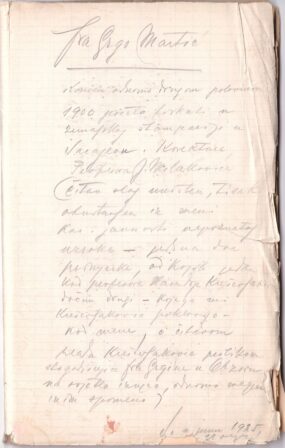
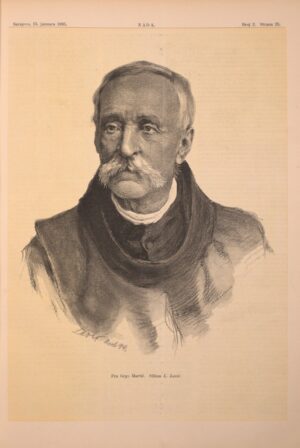
This version, was created by Bosnian Franciscan Fra Grgo Martić[i]. Fra Martić started his work on the Odyssey in 1892. He rewrote the entire Odyssey according to the edition of Matica Hrvatska from 1882 in Zagreb. The printing of this translation began in 1897, but was interrupted, due to unknown reasons.
Letter blocks were prepared for printing, and proofreading of the first eight cantos and one hundred and eighty-five verses of the ninth canto were already completed. The ninth, tenth, eleventh and one hundred and five verses of the twelfth canto were still work in progress, also, the remaining cantos were unavailable in manuscripts, kept in a chest in Fra Grgo’s memorial room in the Kreševo monastery. Later researches said that this manuscript is missing.
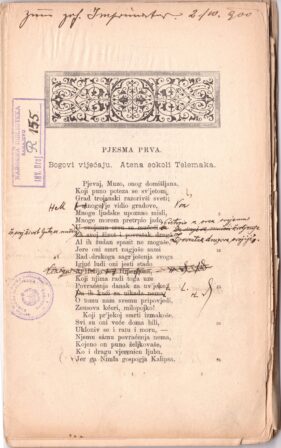
The special collections of the National and University Library of Bosnia and Herzegovina keeps the finished part of the Odyssey. It is part of Aleksandar Poljanić[ii]‘s Collection. Besides the Odyssey, the Library holds Poljanić’s note saying “printing started in printing house Zemaljska štamparija at the end, i.e. second half of 1900s. Proofread was done by Josip Milaković[iii]. The Complete set of letter blocks destroyed for reasons unknown to me, as well as to the public.”
[i] Bosnian Franciscan born in Bosnia and Herzegovina (Rastovača near Posušje, Bosnia and Herzegovina, 24 January 1822 – Kreševo, Bosnia and Herzegovina, 30 August 1905). Known as Grga and Mato, pen name Ljubomir Martić Hercegovac. Besides his religious profession, fra Martić was writing for different journals, as well as lyrical and epic poems, publishing books (with Fra Jukić, in 1858 published Folk Songs of Bosnia and Herzegovina) and he was translating works of Homer, J. Racine, F. R. de Chateaubriand and L. N. Tolstoy. Fra Martić ordained as a priest in 1845 in Travnik, served in various Bosnian towns, and worked for most of his life as a parish priest in Sarajevo. From 1878 he lived in the Kreševo monastery.
[ii] Aleksandar Poljanić (1884 – 1948), probably one of the most important Bosnian-Herzegovinian collectors (numismatist, philatelist, bibliophile), long-time director of the National Bank of Bosnia and Herzegovina. Unknown to the public for a long period because of his status as an “associate of the occupiers” (WWII).
[iii] Josip Milaković, Croatian writer. He abandoned his education as a priest at the Zagreb seminary and in 1883 took a job as a journalist at Obzor. After passing the teacher’s exam, at the invitation of S. S. Kranjčević he went to Bosnia in 1887, where he worked as a teacher for a short time in Derventa, and then in various Sarajevo schools.
*The drawing of the Fra Martić was published in journal Nada from Sarajevo. God. 1, br. 2 (15. januar 1895), str. 25