


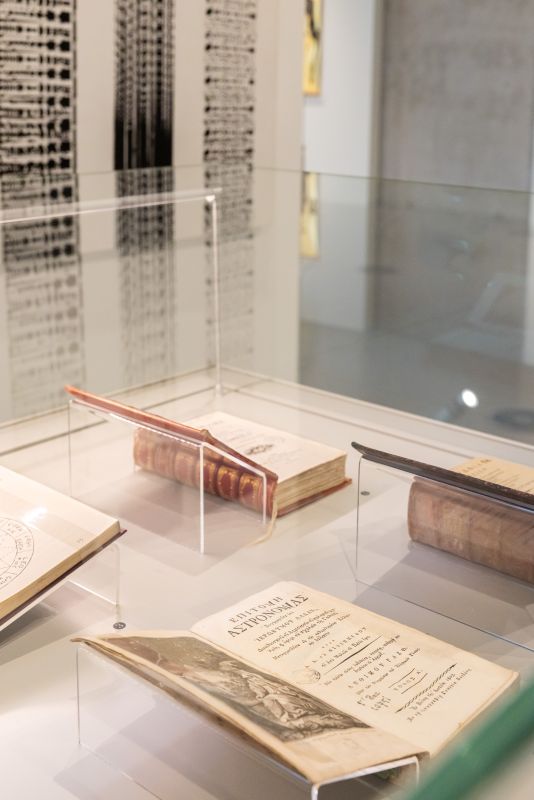
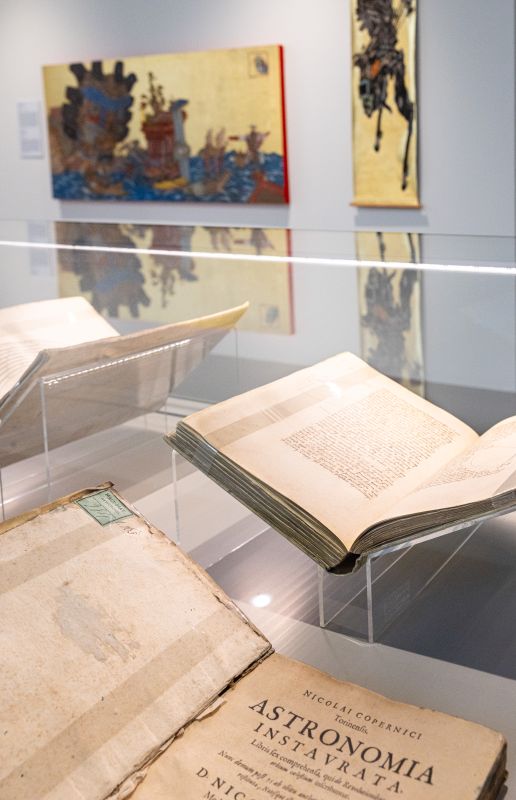
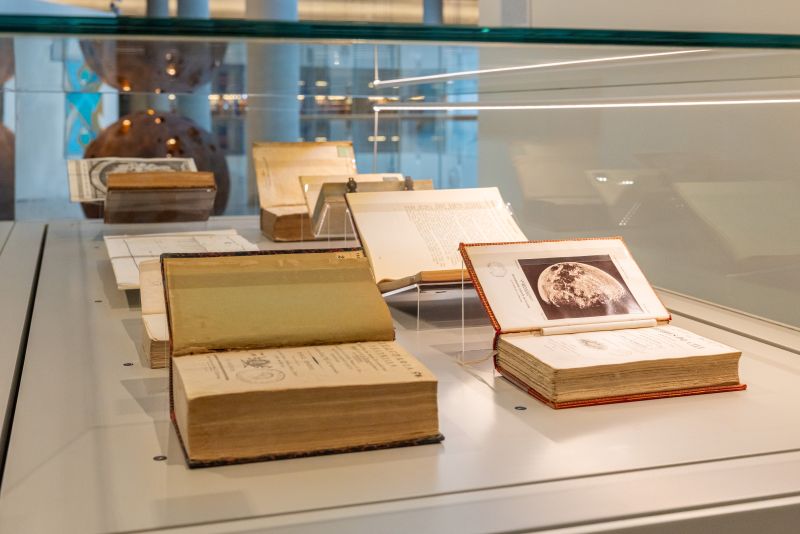
The National Library of Greece participates in the exhibition Synastry with a selection of manuscripts and rare printed books from its Special Collections. Although these items, as physical objects, date from the 15th to the 19th century, they contain textual sources and scientific discourse spanning from the Hellenistic period to modern times.
The philosophical, mathematical, geometrical, astronomical and astrological texts preserved in them are the result of reflection, inquiry, observation, experimentation and sustained effort to articulate knowledge with precision. Within Synastry, the written word becomes an expression of human intellect, entering into dialogue with contemporary art, poetry and music and creating a multilayered field where different modes of perceiving the universe, the stars and their relationship to earthly nature and humanity converge.
Of the 26 items contributed by the National Library, four are manuscripts and the remaining are rare printed books. The manuscripts testify to the long-standing attempt to understand the heavens through the natural sciences. Texts on spherical geometry, astronomy and astrology from the 16th and 17th centuries coexist with works by Aristotle, Aristarchus, Cleomedes and other significant authors. Their variety highlights the intersection of several fields—from mathematics to theology—and the continuity of the Greek scientific tradition.
The rare printed books reflect major transformations in the history of scientific thought through editions of works by Copernicus, Galileo, Tycho Brahe and other important figures in cosmography, astronomy, philosophy and astrology. At the same time, Greek translations printed in Vienna in the late 18th and early 19th centuries, along with publications documenting systematic comet observations and astronomical calendars, trace the dissemination of modern European scientific ideas into the Greek-speaking world.
In Synastry, the Special Collections of the National Library of Greece — its rare books and manuscripts — function as active participants, highlighting the Library’s role not only as guardian of written cultural heritage, but also as an institution that reintroduces historical material and opens new interpretive pathways for engaging with knowledge.
 © National Library of Greece
  © National Library of Greece
  © National Library of Greece
  © National Library of Greece
  © National Library of Greece