


From Shadows into Light, which opened at the National Library in Prague on 4 August 2026, presents the results of long-term provenance research carried out by Czech historians. By examining ownership marks preserved in individual volumes, researchers have been able to reconstruct the journeys of books looted from Jewish communities, institutions and private owners during the Second World War and, in many cases, identify the collections to which they originally belonged.
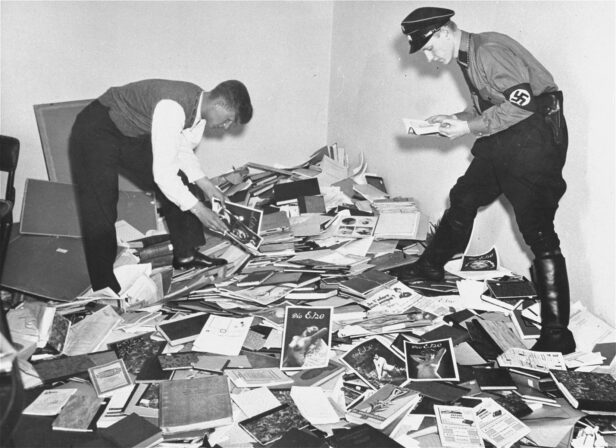
The public burning of books by Jewish authors and other works labelled “un-German” in 1933 became one of the most notorious symbols of Nazi repression. Less well known is the parallel effort to collect and appropriate Jewish books for the purposes of Nazi research and propaganda.
From the mid-1930s onwards, Nazi institutions systematically confiscated the libraries of Jewish communities, synagogues, rabbinical seminaries and private individuals. Following the Anschluss of Austria and the Kristallnacht pogroms of 1938, these seizures expanded dramatically across occupied Europe.
Looted books were transported to research institutions in Berlin and Frankfurt am Main, where the Nazis sought to assemble an unprecedented collection of Judaica. Among the institutions involved was the Institute for Research on the Jewish Question (Institut zur Erforschung der Judenfrage), established to study Judaism through the lens of Nazi racial ideology and to provide material for antisemitic propaganda.
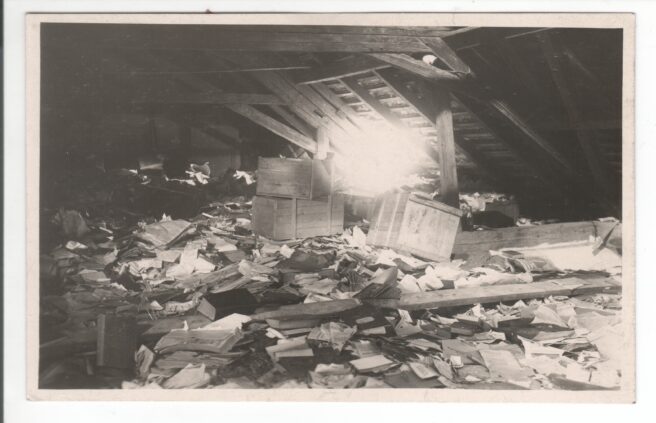
As Allied bombing intensified in 1943, more than half a million books were evacuated from Berlin and Frankfurt to repositories in the Sudetenland, including the castles of Mimoň, Nový Berštejn and Nový Falkenburg, as well as Houska Castle. Books originating from across Europe were stored there, often in extremely poor conditions. After the war, the books were gradually transported to Prague, and in the early 1950s staff of the National Library continued their cataloguing. Today, these collections offer researchers an extraordinary opportunity to reconstruct the histories of individual volumes and their former owners.
The exhibition demonstrates how provenance research can recover information that Nazi perpetrators attempted to erase. Stamps, ex libris, handwritten annotations and old shelfmarks can all provide crucial evidence. “Every stamp, ex libris, handwritten note or shelfmark is an important clue that can help us identify where a book came from,” explains Jana Jirásková, who leads a team of historians at the Centre for Documentation of Property Transfers of Cultural Assets of WWII Victims. Their research has identified books originating from collections in cities including Olomouc, Vienna, Budapest and Munich.
The exhibition therefore moves beyond the history of Nazi confiscation itself. By reconstructing the provenance of individual books, it also brings back into view the people and institutions whose libraries were dispersed or destroyed. Judaica have formed part of the collections of Prague’s public university library since its establishment in 1777. However, some of the most remarkable items now held by the National Library arrived under very different circumstances.
Among the objects displayed in the exhibition are two early printed books from Venice: an edition of Maimonides’ Mishneh Torah, one of the fundamental works of medieval rabbinic literature, and a pietistic work associated with the Kabbalistic tradition of Safed.
As Tomáš Foltýn, Director General of the National Library of the Czech Republic, explains, such books bear witness to the enormous post-war movement of cultural property. The National and University Library in Prague participated in securing and processing vast quantities of books that had been displaced, confiscated or abandoned during and immediately after the war – at a time when books were, in his words, counted “not individually, but in crates, bundles and wagonloads”.
Understanding how these volumes entered today’s collections is therefore an essential part of understanding the history of the collections themselves.
One of the most significant groups represented in the exhibition comes from the library of the Rabbinical Seminary in Budapest. During the war, the Nazis confiscated almost 3,000 books belonging to the institution. Most were returned to Budapest in 1988–1989. The restitution also included sixteen unique manuscripts documenting the history of Hungarian and Central European Jewish communities.
For Balázs Tamási, Director of the Library of the Rabbinical Seminary – University of Jewish Studies in Budapest, restitution is about more than the physical return of cultural objects. Provenance research can reconnect them with the historical and cultural contexts from which they were removed.
By reconstructing the histories of these books, researchers can illuminate both the mechanisms of Nazi cultural looting and the lives of Jewish communities that were destroyed or dispersed during the Holocaust. In this sense, identifying a stamp, inscription or shelfmark is not merely a bibliographical exercise. It can restore a fragment of a history that persecution sought to erase. From Shadows into Light is presented by the National Library of the Czech Republic in cooperation with the Centre for Documentation of Property Transfers of Cultural Assets of WWII Victims.