


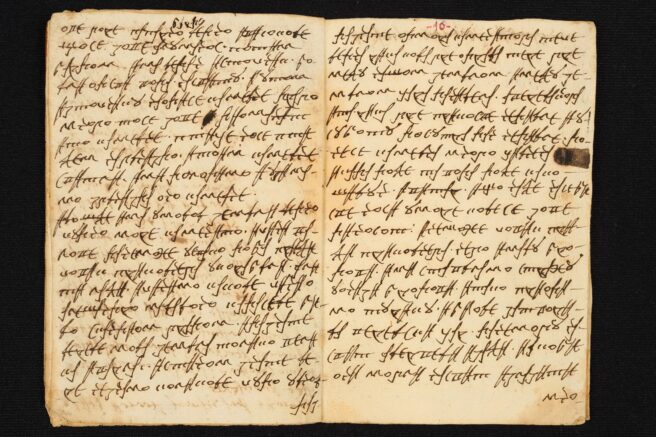
“The Book of King Perpetijan”: The Mystical Manuscript in bosančica script is housed in the Special Collections Department of the National and University Library of Bosnia and Herzegovina.
The Book of King Perpetijan is the only preserved manuscript in Slavic vernacular and bosančica[1] script that tells a medieval utopian legend about the wealthy Indian empire, strange creatures and the nations of Gog and Magog.
The text is the only preserved vernacular copy of the Legend of the Indian Empire in the South Slavic area and it was created in the 18th century. The basic text of the legend was formed in the 12th century as the Letter of Prester John (Latin: Presbyter Ioannes) to the Byzantine Emperor Manuel Komnenos, in the Poljica documents[2], it was sent to the Roman Pope. In the Slavic tradition, this text is called the Legend of the Indian Kingdom (Skazanie o Indijskom carstvu). In that letter, the legendary Prester John, who presents himself as a sovereign king, rules a vast and incredibly rich land, which is full of gold, silver and precious stones. Strange creatures live in it and it is full of different marvels.
The legend quickly spread throughout Europe, there are numerous versions of the text in different languages: Latin, Hebrew, French, Italian, Old Slavonic, etc. The text of the legend itself absorbed various motifs: from ancient and medieval literary and pseudo-historical texts, through European fantasies about the Orient, to stories of Alexander Romance, and the Bible. However, not everything is ideal in India ruled by John. For example, the nations of Gog and Magog (in the Poljica version Got and Magot) can be found. They are the Old Testament harbingers of the apocalypse, who are mentioned in the New Testament and the Qur’an. Texts talk about cannibals, kings of impure nations whom Alexander the Great drove into the mountains and then surrounded them with large gates.
Dr Mehmed Kardaš, associate of the NUBBiH and researcher, after reading, transliteration and many other researches, says that this manuscript from Aleksandar Poljanić Collection and Poljica documents in the Special Collections of the National and University Library of Bosnia and Herzegovina, is the only preserved vernacular copy in the wider South Slavic area. There are transcripts in the Old Slavic language: Serbian, Bulgarian and Russian, but the Old Slavic version has not been preserved in the West. However, the existence of a Croatian Glagolitic translation of the legend is a very basic assumption, especially if we bear in mind that representations of India appear, for example, in the prologue of Dundo Maroje[3] by Marin Držić. In addition, the path of movement of the text is from the west to the east, and the version of the text preserved in the NUBBiH probably originated from the Italian version. Some names also speak of this, such as Sandro Mano for Alexander the Great, probably also the name Perpetijan (ital. prete Gianni).
[1] Bosnian Cyrillic script
[2] Poljica documents are part of the Aleksandar Poljanić Collection preserved in the Special collections of the NUBBiH. Documents are from the Poljica Republic, an autonomous community in nowadays Croatia, that had its own legal system and statute in 1440.
[3] Comedy. It is said to have been first performed in 1551 in the main hall of the Grand Council of the Republic of Ragusa by the company Pomet. Taking place in Rome with characters from Dubrovnik, the play consists of two prologues and five acts, from which the ending did not survive.